I am both humbled and honored to be a new contributor to WBUR, Boston's NPR news station's Cognoscenti. Today my first piece, The Children Who Didn't Survive, was published. I would welcome your comments and feedback both on my blog and on the Cognoscenti site.
Each year, early in October, a letter
arrives with the return address of Massachusetts General Hospital, 55
Fruit St, Boston, Mass. I know immediately what the envelope contains
and I pause and reflect for a few moments before I open it. Inside is an
invitation to return to the place where my son, Nick, was treated for a
deadly form of cancer when he was 14. We, as a family, also spent many
days, weeks, months in this place: crying and laughing; watching
fireworks magically unfurl in the dark sky over the Esplanade from
windows on the 18th floor of the Ellison Building; waiting in the
subterranean operating room holding areas in the warrens beneath the
hospital; exploring the empty hallways late at night like the actors in
“A Night at the Museum”; holding impromptu guitar jams in Nick’s
hospital room; and ringing in the new year with noisemakers, shrimp
cocktail and sparkling cider with hospital staff who drew the short
straw and had to work on New Year’s Eve.
Nick died 12 years ago, so why do I still return to this place each
year? It is because Nick, like the other children who were cared for in
this huge, often anonymous institution are not forgotten — they are
remembered and honored year after year with the annual Pediatric
Memorial Service. In this medical mecca, children are not supposed to
die. We are fortunate to have some of the best and brightest medical
institutions in the world at our doorstep. Reports of miraculous new
cures abound in the media, but there are some children who are not the
success stories that are highlighted in hospitals’ marketing materials.
They are the children who didn’t survive.
Those of us who receive an invitation to return to MGH each year for
the Pediatric Memorial Service are a disparate group. Some of our
children died when they were adolescents, some when they were in early
childhood. Some died from a chronic illness, some from an acute
infection or disease, and others suddenly by an accident. We come from
different walks of life and professions. We speak different
languages. Yet, on this day, year after year, alongside the staff who
cared for our children, the barriers are lifted and we are all together
as human beings, remembering the stories, sharing a hug, speaking our
children’s names, and trying to find meaning in loss. Collectively, we
understand the unique grief of losing a child.
The author pictured with her son Nick in 1997. (Courtesy)
Early in my professional career as a nurse, I heard a young physician
say, “I don’t do death.” I’m not sure what this statement really meant —
perhaps that somehow his superior knowledge could forestall death
permanently? — but beyond its arrogance, it spoke of fear and
hopelessness. As a society we are very isolated from pediatric death. We
are fortunate that in the span of a few short decades we have seen a
dramatic decrease in childhood deaths due to vaccines, antibiotics, and
advances in medical treatments. But this decrease has created a void in
our health care professionals’ ability to know how to deliver care when
finding a cure is no longer an option. Our medical and nurse training
programs don’t “do death” well either, especially around societal
taboos.
A physician at this year’s memorial service gave me hope for the
future when she commented that her role as a doctor is to walk the
journey with her patients and families and this includes the full
spectrum of life and death. We look to our healers to cure us with the
modern arsenal of medicine at their disposal, but when a happy ending is
no longer possible, shouldn’t it also be their role to help guide us
through the fear of the unknown and unthinkable, especially in
pediatrics?
Perhaps learning to step into the full spectrum of life and death is
the meaning that the children who didn’t survive bring to the practice
of medicine. Our kids have become the teachers, no matter how short
their lives may have been. Their legacy is to continue to teach the
healers how to walk alongside those who are confronting the unimaginable
and unbearable with grace, humility and humanity.
So, I guess I keep coming back to walk through the doors of
Massachusetts General Hospital year after year to remember, share a
story, and to say thank you for honoring these great teachers who keep
medicine honest, healing and humble — the kids who didn’t survive.
During the month of November I invite you to join me in composing a daily haiku -- a great way to drop into mindfulness during your day. It doesn't take long and you don't need to think of yourself as a poet or author...simply describe what you see around you--in this moment. The difficult part is parsing this down to 17 syllables.
Mindfulness is about being present with awareness as our life unfolds, very similar to crafting a haiku. Join me in my month long Haiku Rally by posting your haiku in the comment section below and sharing the Haiku Rally with your friends.
I am fascinated by the complexity yet the simpleness of haiku. I remember writing haiku in elementary school...carefully choosing words that would fit in the 5-7-5 syllabic pattern. I have recently rediscovered haiku as a way to pare down disparate thoughts and emotions into a mindful moment in time. Capturing a moment in 17 syllables. Here is my haiku for today:
Time Change
Extra hour today
Or so it seems this morning
Precious and fleeting
Want to join me in capturing moments through haiku? I would love for you to share yours in the comment section of this blog...a grassroots virtual "haiku rally"!
Feeling a little stressed? We are constantly dealing with a myriad of stressors, both external and internal, in our lives. Throw on top of these "normal" stressors the added stress of caregiving and we are often pushed over the edge from coping to crisis. Do you want to learn some simple to implement tools of relaxation and mindfulness into your life to create moments of calm in your busyness?
I will be presenting one of my most popular workshops: Creating Calm Within Crisis on Tuesday, November 12 at Chestnut Park in Brighton, MA -- this workshop is free and open to professional and family caregivers. Join me for refreshments and networking beginning at 5:00 PM.
Please register with Dorothy Garfield at 617-536-1700. Hope to see you on November 12.
There is a curious phenomenon that happens when people survive a great loss, after the numbness of grief begins to subside there seems to be a primal need to begin to make sense of the loss, in a way Viktor Frankel wrote about this over 60 years ago in his book, Man's Search for Meaningand NPR explored this need in their story about finding meaning the death of a child. I encourage you to think back about your own losses, have you found a way to create meaning in your life informed by your darkest times? This is the essence of resilience...shifting from mourning to meaning making.
How does technology mesh with mindfulness, or should I say is it possible to find some connection between the two? Yes, I do believe it is possible, but it must be deliberate use of technology. One of my favorite ways to connect technology with mindfulness is a daily practice I started several years ago. My very first email I open each day is one from Panhala (meaning "source of fresh water" in Hindi). Each day I spend a few moments of awareness with a new poem that speaks to mindfulness, compassion, life. Panhala is a free yahoo group, open to anyone who would like these moments of contemplation delivered to their inbox every day. Today's poem was especially appropriate:
"Even if something is left undone, everyone must take time to sit still and watch the leaves turn."~Elizabeth Lawrence
Do you find
yourself sharpening your pencils and being compelled to buy school
supplies each September, even if you and/or your children left the
classroom many years ago?
For me the shift from summer to autumn
has always been one of eager anticipation for a new year, filled with
new challenges, ideas and opportunities. However, often the desire to "do" overshadows the essential need of the human body and mind to simply "be"
in this exquisite time of year. I am intrigued by the quote above from
Elizabeth Lawrence; is it possible to take time to sit still and just
watch the leaves turn? This autumn I am making a commitment to slow
down, sit still and simply "be" as I watch the leaves explode in their magnificent finale for 2013. Will you join me?
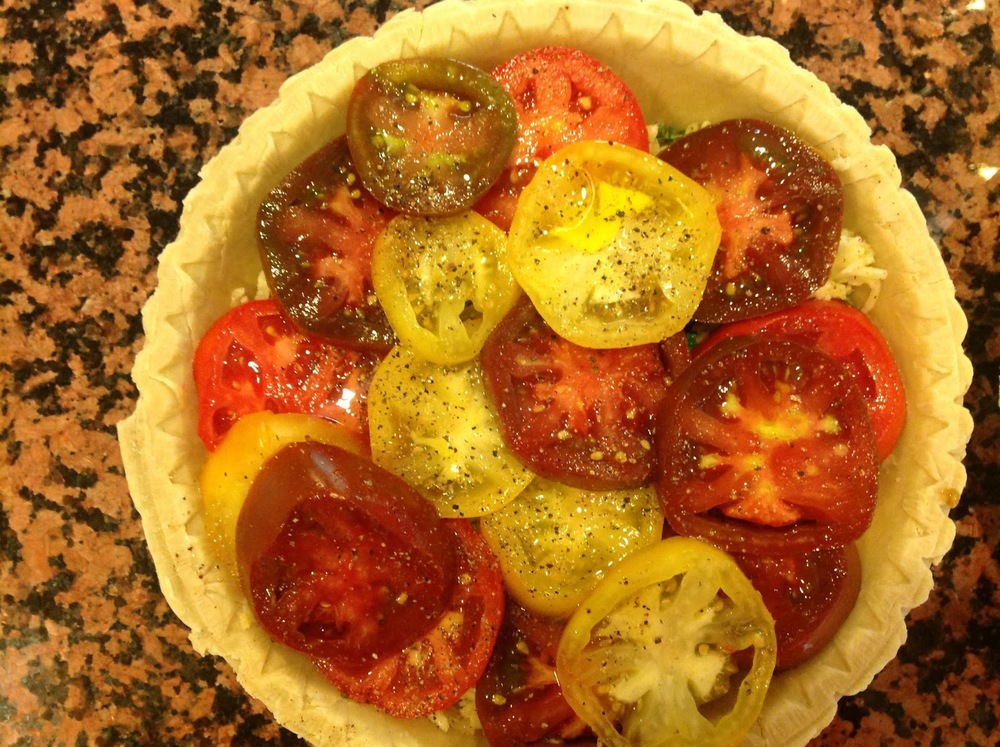
More mindful culinary musing....Until two years ago, I had never heard of a tomato pie much less tasted one. Then my sister, Hilary Gould, shared a recipe with me for
Tomato Pie, a southern delicacy. Since I had an abundance of heirloom
tomatoes from our local CSA farm, I gave the recipe a try. It was LOVE at first sight and first bite. Tomato Pie has become a late summer favorite in my house and hope it will in yours....Enjoy!
Heat 1T EVOL over medium heat, add onion and cook, stirring until
golden -- cool
Thinly slice tomatoes, toss with 1t kosher salt, place in
colander and let drain for approx 30 min
Combine 3/4 c manchego, mozzarella, mayo, breadcrumbs, 2T
chives and 2T parsley, thyme, 1/4 t kosher salt, 1/4 t pepper and the sautéed
onion in a bowl.
Spread mixture in unbaked pie crust
Arrange the tomatoes on top
Drizzle with the remaining 1T EVOL and season with pepper.
Bake until the tomatoes are browned (about 50 min).
Top with the remaining 1T each of chives and parsley
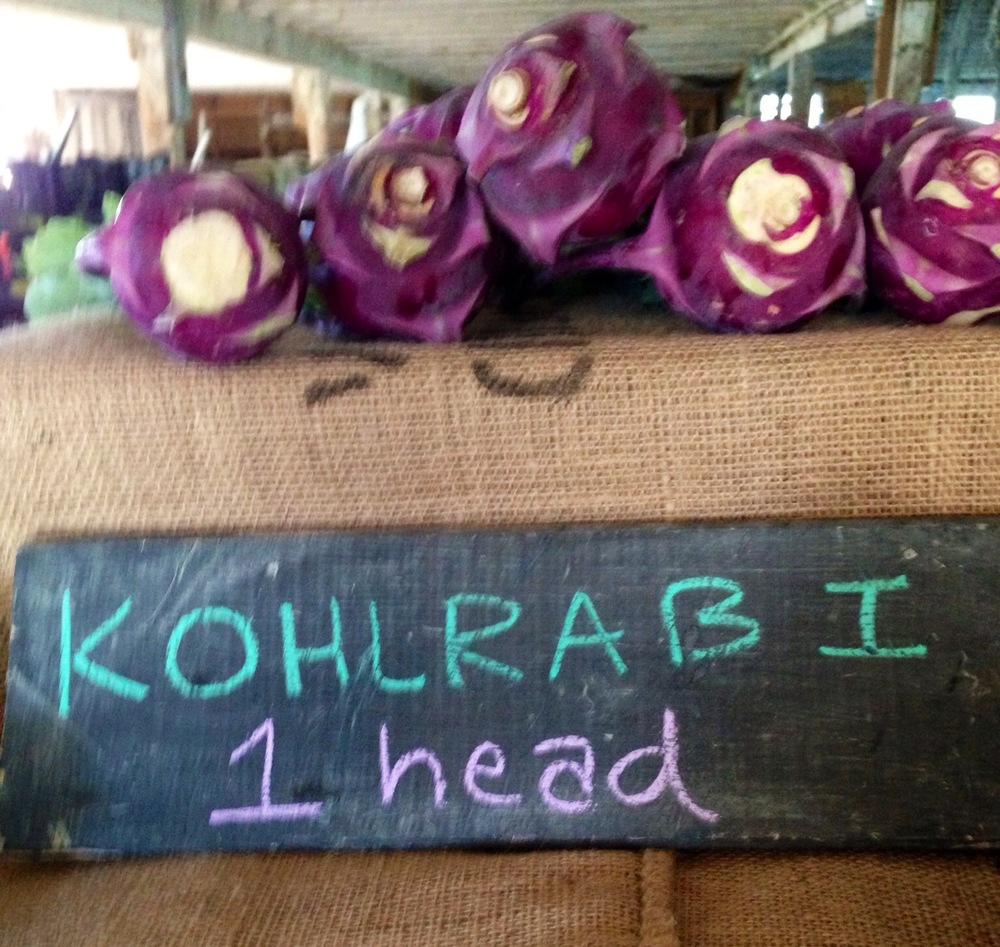
It's that time of year again...when our local CSA (community supported agriculture), First Root Farm opens for the season. For the past several years, beginning the first week of June and ending around Thanksgiving, we have enjoyed a new way of eating....only local, seasonal vegetables. This is more of a challenge than first imagined, but always a wonderful exercise in mindfulness and curiosity. One cannot get too comfortable with tried and true recipes. Let's be honest, how many times have you needed to figure out what to do with kohlrabi at 6 pm? Looking forward to lots of mindful cooking, thanks to our farmers, Laura and Nina.
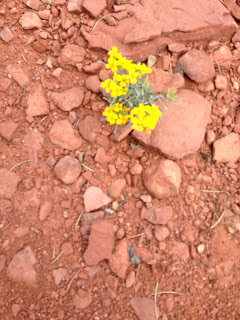
Awe-Inspiring, Powerful and Resilient...these
were the words that came to me as I drank in the breathtaking beauty of
Sedona, Arizona on April 12. Less than 72 hours later, on April 15, I
was back in Boston and blindsided by the emotional rollercoaster that
ensued following the Boston Marathon bombings.
As the new normal has
begun to settle into Boston, as it did in the weeks and months following
9/11 in New York City, those same words that resonated with me as I
scanned the magnificent vistas in Sedona, surface as I continue to
witness the amazing ability of the human spirit to bounce back from
adversity; tenacious and strong...Awe-inspiring, Powerful and Resilient.
This
is the season when the ground swells with new life, trees burst forth
with magnificent blossoms and the earth seems to come alive once more. I
am struck by this dichotomy more acutely than usual this year: As I
breathe in the sweet fragrances of April, I am also preparing for a
journey to Arizona to help my mother prepare for the burial of my
stepfather. The yin and yang of life -- birth and death, always
teetering in some sort of cosmic balance.
I often wonder; would
the spring be less exciting and glorious if we never had winter? Do we
somehow need the reminder of life's fragility and impermanence to
treasure the innate beauty of the present moment?
And so, as the musing
continues, I am filled with gratitude for the wake-up call I receive
each spring when I am renewed with awe and wonder.
I was pleased to learn that the award winning poet, Naomi Shihab Nye is the 2013 Robert Creeley Foundation Winner and will be presenting a reading of her poems in the Boston area (Acton-Boxborough High School, Acton MA) on Wednesday, March 6 at 7:30 PM.
One of her poems, Kindness, is a particular favorite of mine. I was first introduced to this poem when I was training to teach mindfulness at the Center of Mindfulness in Medicine, Health Care, and Society. What struck me when I first read the poem and as I re-read the poem again and again is the notion that experiencing loss opens one to the ability to give and receive kindness more wholly.
What do you think? I would love to hear your thoughts and comments...do we need to lose things before we can find kindness?
Kindness (Naomi Shihab Nye)
Before you know what kindness really
is
you must lose things,
feel the future dissolve in a moment
like salt in a weakened broth.
What you held in your hand,
what you counted and carefully saved,
all this must go so you know
how desolate the landscape can be
between the regions of kindness.
How you ride and ride
thinking the bus will never stop,
the passengers eating maize and chicken
will stare out the window forever.
Before you learn the tender gravity
of kindness,
you must travel where the Indian in a white poncho
lies dead by the side of the road.
You must see how this could be you,
how he too was someone
who journeyed through the night with plans
and the simple breath that kept him alive.
Before you know kindness as the
deepest thing inside,
you must know sorrow as the other deepest thing.
You must wake up with sorrow.
You must speak to it till your voice
catches the thread of all sorrows
and you see the size of the cloth.
Then it is only kindness that makes
sense anymore,
only kindness that ties your shoes
and sends you out into the day to mail letters and
purchase bread,
only kindness that raises its head
from the crowd of the world to say
it is I you have been looking for,
and then goes with you everywhere
like a shadow or a friend.
Keep Calm and Carry On...have you been noticing that ubiquitous phrase and simple poster as much as I have lately? It seems to be everywhere! It has morphed into all forms of iterations as evidenced on Pinterest boards and Esty.com. I was curious about where this saying came from and was surprised to learn that it first appeared in war torn England during the devastation of World War II as one of three propaganda posters that were distributed and hung in prominent public places. In fact it was meant to build resiliency among the people who had lost so much and were starting to rebuild their lives from the rubble.
Throughout our lives, we will rebuild and reconstruct our lives through transitions, changes, joys and sorrows. Perhaps this simple phrase on the red and white poster can instill within us the same sense of resiliency as it did more than half a century ago.May we all...Keep Calm and Carry On
Great video of the history of the WWII poster: Keep Calm and Carry On
As news of the horrific events in Newtown, Connecticut unfolded on Friday and over the weekend; 20 first grade students and 6 school staffmurdered by a mentally ill young adult, my thoughts turned to those left behind...the families, friends and classmates. How will they begin to heal after suffering such unimaginable pain? I don't have any profound answers; I am without adequate words to comfort or explain such loss. After the memorial services have been held and the news media have moved on to new disasters, how will the broken hearts in Newtown begin to heal? As one who has experienced every parent's worst nightmare, the loss of a child (my son Nick), perhaps this reflection, which I shared at last year's Pediatric Memorial Service at Massachusetts General Hospital and have also shared previously on this blog, may provide some hope for those beginning their journey of healing.
Sunday, November 6, 2011 ~ Massachusetts General Hospital, Boston, MA
"The only whole heart is a broken one...it lets the light in" ~Rabbi David Wolpe
"There
are few choices afforded to us in how to survive the loss of a child.
Well meaning friends, relatives and professionals may advise us "not to
let this tragedy define who we are", but I will have to respectfully
disagree with this advice. The tragedy of losing a child is a life
changing event like no other: We are confronted with not only the loss
of one we deeply love, but with the loss of our future as we had
envisioned. We are shaken to the very core of our existence and
essence. Yes, this event will define us for the rest of our lives
whether we want it to or not.
When
our loss is new, it is unfamiliar and terrifying in its intensity. I
vividly remember waking up the morning after Nick died and being
absolutely amazed and incredulous that the sun had the audacity to rise,
that the school bus continued on its scheduled route down my street,
that people went to the grocery store, commuted to work and that the
mail was delivered...the outside world continued to function as if
nothing had occurred. It was a surreal scene. Because for me it was as
if a nuclear bomb had been detonated. The world as I had known it had
been destroyed with the death of my son. My world now was defined as a
new normal even though I wished desperately for the old normal to
return.
Rabbi
and author, David Wolpe, aptly describes the feeling of new loss in
this way "When we experience a loss, a hole opens up inside of us. It
is almost as if the loss itself plows right through us, leaving us
gasping for air" and we bleed profusely through this opening. During the
early days, months and years after our loss, we focus on how to slow
down this hemorrhage, this continuous emptying of grief. But then
something begins to change, very, very slowly; the immediate agony
subsides. Around the edges of that opening, things begin to heal and
scar tissue begins to form. This is the point at which we can choose
how the tragedy of our loss will continue to define our lives...we can
choose to allow the scar tissue to continue to form and thicken,
closing the hole within us -- hardening us to the world with the
unfairness and unjustness of our loss; or we can choose to allow the
hole to remain open, allowing not only the stream of grief to flow out
but permitting light, hope and meaning to enter. I have chosen to allow
the hole within me to remain open and this is one of the gifts my son
has given me.
Rabbi Wolpe suggests that "The only whole heart is a broken one, it
lets the light shine in." Allowing the hole to remain open, has allowed
me to be a more compassionate person to others and myself, perhaps a
bit less judgmental and more empathetic than I was in my old normal.
Keeping the hole open has made it easier for me to prioritize what
really matters and not what I thinkshouldmatter
-- it now OK to say no to mundane tasks and yes to things that feed my
soul. I do not fear many things now -- after all the worst has happened
to me, so what do I have to be fearful of now? And most important, by
keeping the hole open, continuing to allow the grief out and the light
in, I am able to hold Nick and the meaning of his life close.
So, perhaps I have what the professionals call a "maladaptive coping strategy", but I embrace the notion that yes, I have let
this tragedy define me in a way I never imaged would be possible; by
allowing my heart to remain broken, and open, it is, in my new normal,
whole once more."
For several years I have been pleased to donate my blog space over the Thanksgiving weekend to a wonderful project: Engage with Grace. For me end of life discussions are not an abstract concept, as I have journeyed with both family members and clients down this path. Talking about end of life is not easy, but it does not need to be the taboo subject that it is currently in our culture. If in less than a generation we have shifted our cultural norms on other topics that certainly were never discussed in the past: cancer, erectile dysfunction, birth control, and feminine hygiene products then certainly we can start a revolution to normalize the discussion about end of life decision making!
This year I am expanding my participation in Engage with Grace to include the entire holiday season, not only Thanksgiving weekend. Let's begin changing the culture by making it a priority to ask and listen to your friends and family about end of life wishes before we ring in 2013.
Engage With Grace This Holiday Season
"One of our
favorite things we ever heard Steve Jobs say is… ‘If you live each day as if it was your last, someday
you'll most certainly be right.’
We love it for three reasons:
It reminds all of us that living
with intention is one of the most important things we can do.
It reminds all of us that one day
will be our last.
It’s a great example of how Steve
Jobs just made most things (even things about death – even things he was quoting)
sound better.
Most of us do pretty well with the living with intention part –
but the dying thing? Not so much.
And maybe that doesn’t bother us so much as individuals because
heck, we’re not going to die anyway!! That’s one of those things that happens
to other people….
Then one day it does – happen to someone else. But it’s someone that we love. And everything about our perspective on end
of life changes.
If you haven’t personally had the experience of seeing or helping
a loved one navigate the incredible complexities of terminal illness, then just
ask someone who has. Chances are nearly
3 out of 4 of those stories will be bad ones – involving actions and decisions
that were at odds with that person’s values.
And the worst part about it? Most of this mess is unintentional – no one
is deliberately trying to make anyone else suffer – it’s just that few of us
are taking the time to figure out our own preferences for what we’d like when
our time is near, making sure those preferences are known, and appointing
someone to advocate on our behalf.
The holidays are a time for gathering, for communing, and for thinking
hard together with friends and family about the things that matter. Here’s the crazy thing - in the wake of one of
the most intense political seasons in recent history, one of the safest topics
to debate around the table this year might just be that one last taboo: end of
life planning. And you know what? It’s also one of the most important.
Here’s one debate nobody wants to have – deciding on behalf of a
loved one how to handle tough decisions at the end of their life. And there is
no greater gift you can give your loved ones than saving them from that
agony. So let’s take that off the table
right now, this weekend. Know what you
want at the end of your life; know the preferences of your loved ones. Print
out this one slide with just these five questions on it.
Have the conversation with your family. Now. Not
a year from now, not when you or a loved one are diagnosed with something, not
at the bedside of a mother or a father or a sibling or a life-long partner…but
NOW. Have it this holiday season when
you are gathered together as a family, with your loved ones. Why? Because now is when it matters. This is
the conversation to have when you don’t need to have it. And, believe it or not, when it’s a
hypothetical conversation – you might even find it fascinating. We find sharing almost everything else about
ourselves fascinating – why not this, too? And then, one day, when the real stuff
happens? You’ll be ready.
Doing end of life better is important for all of us. And the good news is that for all the
squeamishness we think people have around this issue, the tide is changing, and
more and more people are realizing that as a country dedicated to living with
great intention – we need to apply that same sense of purpose and honor to how
we die.
One day, Rosa Parks refused to
move her seat on a bus in Montgomery County, Alabama. Others had before. Why was this day
different? Because her story tapped into
a million other stories that together sparked a revolution that changed the
course of history.
Each of us has a story – it has
a beginning, a middle, and an end. We
work so hard to design a beautiful life – spend the time to design a beautiful
end, too. Know the answers to just these
five questions for yourself, and for your loved ones. Commit to advocating for each other. Then pass it on."
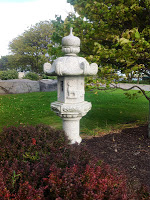
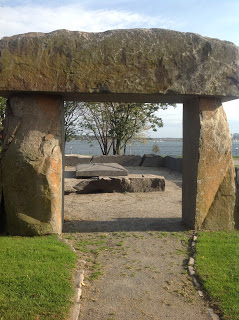
Sustainable resilience...I love the concept of being able to bounce back from challenges and adversity time and time again. But often it is the little things that wear away our resilience, like water wears away stone: the traffic jam on the way to work, the parking space that disappears before our eyes, running late and realizing that you left your phone on the kitchen counter, etc etc. Slowly, invisibly wearing us down drop by drop. One way to help ourselves create a more sustainable resilience is to cultivate mindful moments amidst the trials and tribulations. And so it was for me today...finding incredible beauty on my long walk from a very remote parking space at UMass Boston. These photos were taken on the UMass Boston campus near the Massachusetts Archives Building, sights I never would have seen if I had snagged that first close parking spot.
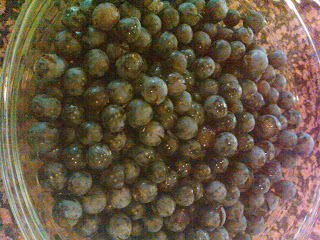
As many of you know, I live in Concord, Massachusetts....home of the shot heard' 'round the world, literary luminaries (Emerson, Thoreau, Alcott, etc), and the Concord grape. When we moved to our current house, less than a mile from Ephraim Bull's (the original propagator of the Concord grape) cottage our then 2nd grade daughter begged us to plant some grape vines on our fence. For many years, the harvest was to be generous... pitiful. Maybe a handful of grapes would be gathered if we were lucky. Well, time and patience has finally paid off...this year we had a bumper crop of Concord grapes. Two grocery bags full are on my kitchen counter! And that 2nd grade daughter who begged for the grape vines on the fence, is now a 2nd grade teacher (as I said, time and patience are key to growing grapes).
A couple of years ago, when our vines started to produce more than a handful of grapes a season, I searched for something unique to do with the grapes and came across a recipe for Concord Grape Pie online. Serendipitously, it was posted on a site called PieChef.com and the "pie chef" was none other than a Concord friend of mine, Jane Fisher.
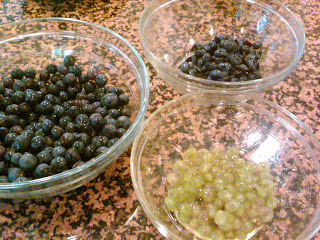
Separating the skin from the pulp of the Concord grapes
Partaking in baking with Concord grapes is a mindful experience -- they are bountiful for only a short time each year in the beginning of September. They do not ship well, so are not often found in bulk in grocery stores nationwide. To make a pie from Concord grapes, one must first stem the grapes, then separate the inside from the skin, and finally remove the seeds. While this may sound like an arduous process, it is actually simple, repetitive, filled with touch, sight, smell, taste, sound and becomes what I fondly refer to as "kitchen meditation".
So it is with mindful gratitude to Jane Fisher that I share this recipe for:
Concord Grape Pie
Preheat oven to 400 degrees.
9" unbaked pie crust (double crust or single crust with crumb topping)
About 1.5 pounds (4 cups) Concord grapes
3/4 - 1 cup sugar (I use 3/4 c)
1/4 cup all purpose flour
1/4 tsp salt
2 TB butter melted
1 TB lemon juice
(I usually make a double crust pie, but if you prefer a crumb topping, follow the recipe below )
Crumb topping
1/2 cup quick or rolled oats
1/2 cup sugar
1/4 cup flour
1/4 cup butter melted
Remove grapes from stems. Slip skins from grapes (it's easy to do, just squeeze gently and the skin will separate from the pulp),
placing the pulp in a medium saucepan and reserving the skins
in a bowl. Bring the pulp to a boil. Reduce heat and simmer for about 5
minutes. The pulp will soften and get lighter in color.
Press the pulp through a sieve into a medium bowl; this will remove the
seeds. Add the skins to the pulp. Melt butter and add butter and lemon juice to
grape mixture.
Concord Grape Pie
In a large bowl, combine the sugar, flour, and salt. Add the grape mixture
and stir well. Pour into an unbaked pie crust and either cover with a crust or sprinkle crumb topping over the top of the pie.
Bake at 400° F for about 40 minutes, until fruit is
bubbling and topping is lightly browned.
"You are the bows from which your children as living arrows are sent forth. The archer sees the mark upon the path of the infinite, and he bends you with his might that his arrows may go swift and far. Let your bending in the archer's hand be for gladness; For even as he loves the arrow that flies, so he loves also the bow that is stable." ~Kahlil Gibran
This excerpt from Kahlil Gibran'sOn Children, echoes in my mind today. My daughters are now adults and this month has been one of great happiness, pride, and inevitable change. Our eldest daughter became engaged to a wonderful man last week and our youngest daughter is embarking on her first teaching position as a second grade teacher in Ohio next week.
I am mindful of the moments of joy and also of the moments of longing for the past, holding tightly to the arrows and resisting their release: the age old parental dilemma. To know when to let go and when to hold on is difficult; it challenges us to relinquish control and embrace vulnerability. And so, it is with a heart filled with pride and gratitude for my daughters, Kim and Jen, that I pull back the bow and release the arrows, watching them soar with strength, beauty and joy into the future.